
Thank you for visiting our website.
This site is exclusively reserved for health professionals.

Une professionnelle de santé en train de travailler

I am a healthcare professional

Un patient est au téléphone

I would like to access the ‘patient’ dental implant website.

Un patient est au téléphone

I would like to access the ‘patient’ website for jaw surgery.

Chin Wing Genioplasty

Genioplastie Chin Wing Global D

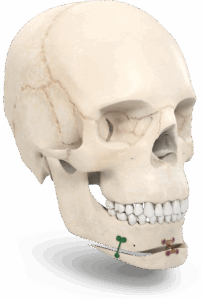
The Chin Wing genioplasty is a continuous basilar osteotomy that allows repositioning of the mandibular line from the right to the left angle, with three-dimensional correction of projection, height, and mandibular inclination.

This technique ensures a harmonious and stable remodeling of the lower third of the face while maintaining bone continuity.


Origin of the Technique

The mandibular wing osteotomy was first described by Prof. Albino TRIACA (Zurich, Switzerland) in 2009 (Triaca et al., IJOMS 2009). It allows:

  • Correction of chin projection and height along the entire basilar length.
  • Redefinition of bone continuity and the mandibular line.
  • Adjustment of the mandibular plane slope according to patients’ aesthetic and functional needs.

Surgical Indications

  • Retrogenia with desired basilar advancement.
  • Vertical deficiency of the lower third requiring mandibular plane lowering.
  • Mild to moderate asymmetries of the basilar border.
  • Global aesthetic improvement without the use of plastic or titanium mandibular angle or symphyseal implants.

Surgical Technique

  • Vestibular access with complete subperiosteal dissection of the basilar border.
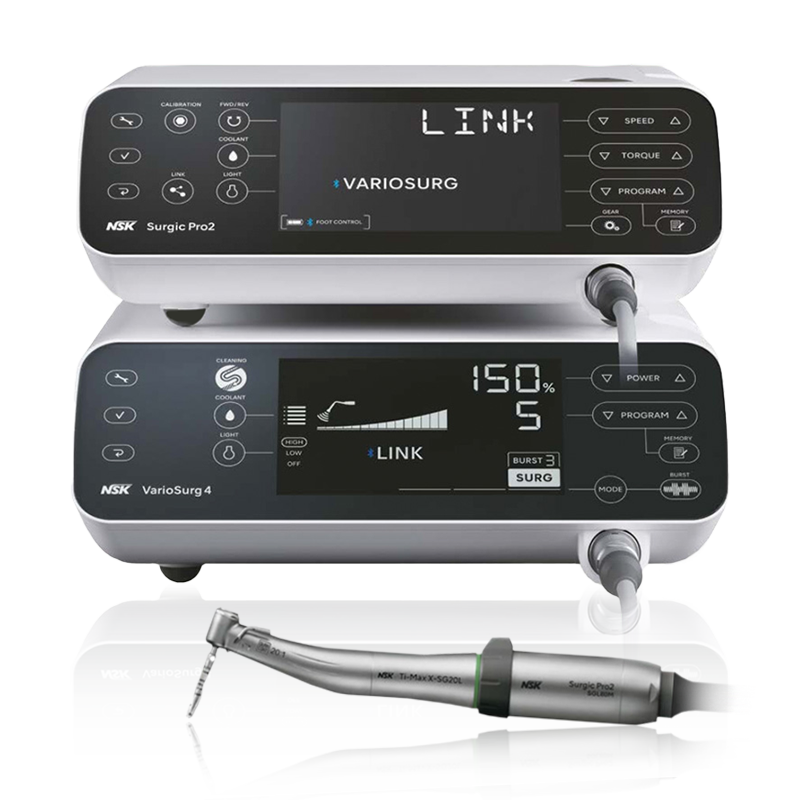
  • Continuous basilar osteotomy (usually performed with a piezotome; the NSK Variosurg 4 may also be used).
  • Mobilization of the basilar segment according to the desired advancement, lowering, and rotation.
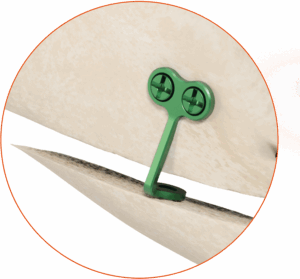
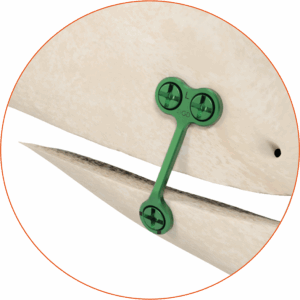
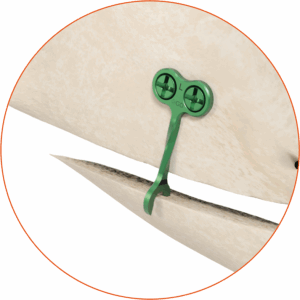
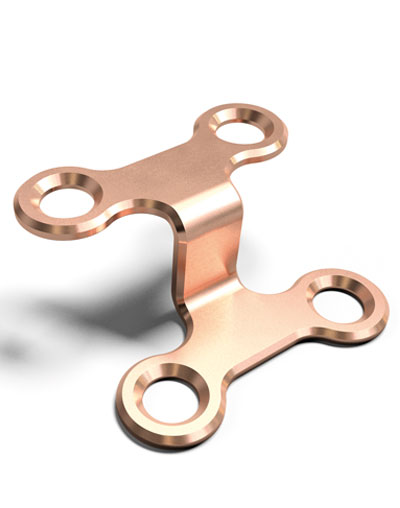
  • Osteosynthesis using a standard genioplasty plate at the front (symphysis level) and, laterally, an additional plate the Chin Wing Global D to maintain posterior spacing and prevent relapse.

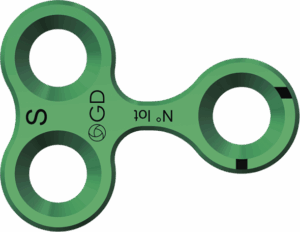
Chin Wing Global D Plate

Fixation of the lower bone flap in Chin Wing genioplasty is performed with a standard anterior genioplasty plate. Laterally, surgeons may choose to add a bone graft.

To address certain relapse cases, especially with significant posterior lowering, Global D and its team of surgeon-designers developed a dedicated osteosynthesis plate designed for reduced bulk, meeting the specific technical and anatomical challenges of this surgery.

Technical Variant: Mini Wing Osteotomy

  • Limited osteotomy from the symphysis to the anterior portion of the mandibular body.
  • Preserves the inferior alveolar nerve and reduces the risk of posterior paresthesia.
  • Indicated when a full Chin Wing is unnecessary or when combined with a sagittal split.
  • Allows advancement and/or lowering of the chin and anterior basilar line.

Advantages: less invasive, safer, and suitable for complex anatomy.

Technical Challenges and Key Considerations

  • Osteotomy trajectory: avoid the mandibular canal and maintain sufficient bone thickness.
  • Extended subperiosteal dissection: complete exposure from angle to angle while preserving vascularization.
  • Mobilization of the basilar segment: careful handling to prevent secondary fractures or steps.
  • Stable osteosynthesis: precise plate adaptation and bicortical screw fixation while respecting nerve structures.
  • Postoperative management: consolidation, maintenance of position, and prevention of paresthesia.

The learning curve is significant — accuracy in osteotomy, control of the mandibular plane, and proper plate adaptation are all crucial for success.

Digital Surgical Planning (VSP)

Digital planning enhances both safety and precision:

  • 3D visualization of the mandibular canal, dental roots, symphysis, and angles.
  • Virtual simulation of osteotomy and repositioning (complete Chin Wing or Mini Wing).
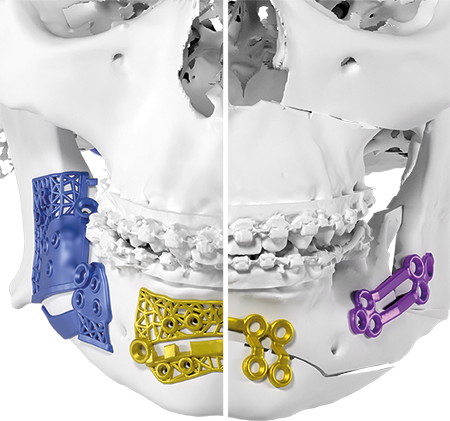
  • 3D-printed surgical guides: optimized saw/piezotome direction and plate placement for Global D.
  • Facilitates communication between surgical team and patient; allows integration with sagittal split or other osteotomies.

Advantages: reduced intraoperative errors, improved aesthetic and functional predictability, optimized operative time.

(Discover Ortrau.tek’s custom-made guides and plates designed to support you in performing Chin Wing genioplasty.)

• Triaca A., Minoretti R., Merz B.R. (2009). Mandibular wing osteotomy for the correction of the mandibular plane. Int J Oral Maxillofac Surg., 38:1210–1215.
• Cavalcanti de Almeida Júnior O. et al. (2019). Mini-wing osteotomy: a useful procedure in orthognathic surgery. Int J Oral Maxillofac Surg., 48:1487–1494.